I read a lot of other lawyers’ work.
When I’m retained to write a petition for discretionary review in the Court of Criminal Appeals, I have to read their briefs. When I see an interesting opinion out of one of the intermediate courts or the CCA I read the briefs that the decision is based on.
It’s not too pretty at all.
![The court of appeals' decision conflicts with that of other courts of appeals' decisions on the same issue and arguably with those of this Court. TEX. R. APP. P. 66.3(a)&(c). The Thirteenth Court of Appeals has held that TEX. PEN. CODE ANN. § 9.32 (Vernon supp. 2019 & 2024) contains no "'legislative purpose' that precludes a defendant from [a jury] instruction" on necessity under § 9.22 and one on deadly force in defense of person under § 9.32. Castro v. State, 2019 Tex.App.LEXIS 6601, at *6 (Tex.App. – Corpus Christi, August 1, 2019, no pet.) (not designated for publication), reaffirming Fox v. State, 2006 Tex.App.LEXIS 7898 (Tex.App. – Corpus Christi, August 31, 2006, pet. ref'd) (not designated for publication), citing Bowen v. State, 162 S.W.3d 226, 228-9 (Tex.Crim.App. 2005).](https://bennettandbennett.com/wp-content/uploads/2026/03/Screenshot-2026-03-29-at-2.43.44-PM.png)
I use that as a writing test for potential law clerks. A fairly competent law student will find 15 errors in this one paragraph. You can probably spot three errors in the first sentence.
It’s the first paragraph of the argument section of a petition for discretionary review. It is intended to convince the Court of Criminal Appeals that the issue is interesting and important. “Interesting and important” is not, I think, the message conveyed by fifteen errors in 129 words.
If I were a judge, this paragraph would make me not want to hear more from this lawyer.
The PDR is one filed by a chief appellate public defender. This is not a dig at appellate public defenders generally. Some of the best appellate lawyers I know are in public defenders’ offices. This is just ordinary appellate lawyering.
Commoditized Error
Ordinary appellate lawyering is not only bad writing, but also cookie-cutter lawyering: read the trial record, find objections, see if error was preserved, brief them. Argue legal insufficiency if you can—that doesn’t require a trial objection. If you see jury-charge language that you know is controversial, argue that it was harmful and that the harm was egregious.
All of this is commoditized error. You don’t need any special creativity to find the errors that anyone can find. Any appellate lawyer can do it. A frontier LLM (Opus 4.6, as of the writing) can do it as well as any lawyer, and can write the outline (but can’t for the life of itself give you accurate quotations from real cases).
But this error that Opus 4.6 and any appellate lawyer can recognize, judges and prosecutors can also recognize. That’s not to say judges don’t commit reversible commoditized error. They do it every day, mostly because:
- trial lawyers don’t recognize it;
- judges listen to prosecutors;
- prosecutors, even if they recognize it, are too arrogant to “lose” an argument that will result in the avoidance of error.
Three Types of Case
So generally we can see three types of case:
- The lost cause. The State tried a clean case, the judge followed the law, and even if the defense made all the right objections there’s nothing that will win on appeal. Maybe 95% of cases.
- The sure thing. The judge screwed something up after trial counsel preserved some error by warning him or her; or the jury charge omitted something that it had to include. Maybe 3%.
- The hidden win. There was error that the defense didn’t object to and didn’t have to; or error on which the law is not yet clear; or error on which the law appears clear but is (because of something that courts have in the past not duly considered) incorrectly decided. Maybe 2% of cases.
100% of appellate lawyers will catch the rare sure thing.
Ten percent of lawyers will reliably catch the error that didn’t have to be preserved.
Five percent will reliably catch the error on which the law is not clear, and will write a brief that will convince the court to clarify the law in this client’s favor.
One percent will reliably find and make the argument that turns the law from unfavorable to favorable.
I’m probably being charitable in those percentages. But here’s a graph showing how I picture it.
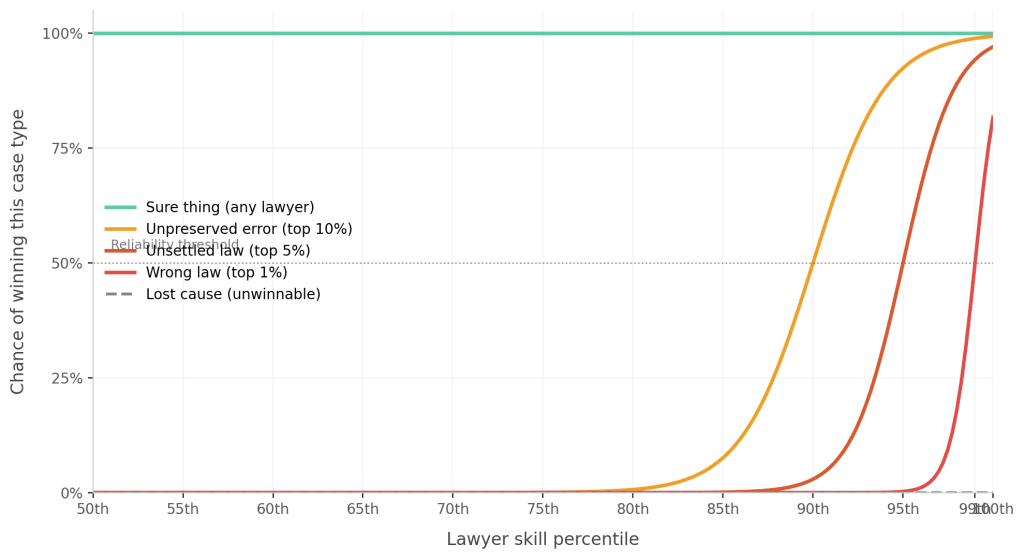
The interesting stuff happens between 0% (the case nobody could win) and 100% (the case anyone could). And in that arena, 80% of appellate lawyers aren’t even showing up to play.
90% of people can’t be in the top 10%. And where—as in criminal appellate law—you have to be in the top 10% to accomplish things that not everyone can accomplish, that means that 90% of people are mediocre.
A Real-Life Hidden Win
Let me give you an example.
S., a lawyer, was convicted in a jury trial of a drug crime. In the trial he had taken on the role of lawyer as well as client. He had cocounsel, so he was not doing it alone.
On appeal, he had appointed counsel, D. When S. sent me D.’s brief draft, I saw that D. had raised three points of error. I reviewed the appellate record and found that the first and second were argued about at trial but the record did not show error, and the third was an ineffective-assistance-of-counsel claim based on trial counsel “opening the door” to admission of a statement that had previously been suppressed, by cross-examining the arresting officer in a way that suggested someone might have planted the drugs on S.
Ineffective assistance of counsel is really hard to prove on direct appeal, because the record on direct appeal almost never shows that the decision was not a valid strategic choice. That was a problem here. The greater problem, however, is S.’s role as cocounsel on the case. You don’t get to claim ineffective assistance of counsel when you were counsel. Even if you could, the record did not show that S. had not acquiesced to his cocounsel’s strategy.
S.’s trial team (which included S.) might have had a strategic reason to open the door to the suppressed evidence. Sometimes as trial lawyers we will let into evidence one thing that we would rather not have in evidence, in order to get something else more important admitted.
But what I wondered, on reading D.’s brief and the trial record, was whether S.’s team had in fact, by aggressive cross-examination of the arresting officer, opened the door to the suppressed statement. You see, the “opening the door” rule is a rule of evidence, and suppression is either constitutional or statutory, and a rule of evidence cannot trump a constitutional or statutory rule.
And in fact the suppression statute, article 38.22 of the Texas Code of Criminal Procedure, includes an opening-the-door provision for impeachment of a testifying defendant. If you get your own statement suppressed under article 38.22, you cannot testify free of impeachment based on that statement. The existence of that provision suggests that the Legislature did not mean for there to be other exceptions to suppression.
So whether it was ineffective or not, S.’s trial counsel’s aggressive cross-examination of the arresting officer did not open the door to the admission of the suppressed statement. That is the point of error that D. should have raised.
Fortunately, I figured this out before the brief was filed, and S. hired me to take over the appeal. We argue it before the court of appeals next month.
I would call this a five-percenter—something on which there is no clear controlling precedent—or maybe even a one-percenter, since everyone else seemed to think the law was clear in a way that I think is clearly wrong.
The fact that D. didn’t even see the issue, despite being appointed to the case and writing a full brief, is the chart in action. D. found commoditized issues (two arguments made in the trial court but for which error was not shown; and an IAC claim that couldn’t survive the record), missed the hidden win entirely, and would have filed a brief that lost a case that should be won.


Posted on
March 29, 2026 in
I read a lot of other lawyers’ work.
When I’m retained to write a petition for discretionary review in the Court of Criminal Appeals, I have to read their briefs. When I see an interesting opinion out of one of the intermediate courts or the CCA I read the briefs that the decision is based on.
It’s not too pretty at all.
I use that as a writing test for potential law clerks. A fairly competent law student will find 15 errors in this one paragraph. You can probably spot three errors in the first sentence.
It’s the first paragraph of the argument section of a petition for discretionary review. It is intended to convince the Court of Criminal Appeals that the issue is interesting and important. “Interesting and important” is not, I think, the message conveyed by fifteen errors in 129 words.
If I were a judge, this paragraph would make me not want to hear more from this lawyer.
The PDR is one filed by a chief appellate public defender. This is not a dig at appellate public defenders generally. Some of the best appellate lawyers I know are in public defenders’ offices. This is just ordinary appellate lawyering.
Commoditized Error
Ordinary appellate lawyering is not only bad writing, but also cookie-cutter lawyering: read the trial record, find objections, see if error was preserved, brief them. Argue legal insufficiency if you can—that doesn’t require a trial objection. If you see jury-charge language that you know is controversial, argue that it was harmful and that the harm was egregious.
All of this is commoditized error. You don’t need any special creativity to find the errors that anyone can find. Any appellate lawyer can do it. A frontier LLM (Opus 4.6, as of the writing) can do it as well as any lawyer, and can write the outline (but can’t for the life of itself give you accurate quotations from real cases).
But this error that Opus 4.6 and any appellate lawyer can recognize, judges and prosecutors can also recognize. That’s not to say judges don’t commit reversible commoditized error. They do it every day, mostly because:
Three Types of Case
So generally we can see three types of case:
100% of appellate lawyers will catch the rare sure thing.
Ten percent of lawyers will reliably catch the error that didn’t have to be preserved.
Five percent will reliably catch the error on which the law is not clear, and will write a brief that will convince the court to clarify the law in this client’s favor.
One percent will reliably find and make the argument that turns the law from unfavorable to favorable.
I’m probably being charitable in those percentages. But here’s a graph showing how I picture it.
The interesting stuff happens between 0% (the case nobody could win) and 100% (the case anyone could). And in that arena, 80% of appellate lawyers aren’t even showing up to play.
90% of people can’t be in the top 10%. And where—as in criminal appellate law—you have to be in the top 10% to accomplish things that not everyone can accomplish, that means that 90% of people are mediocre.
A Real-Life Hidden Win
Let me give you an example.
S., a lawyer, was convicted in a jury trial of a drug crime. In the trial he had taken on the role of lawyer as well as client. He had cocounsel, so he was not doing it alone.
On appeal, he had appointed counsel, D. When S. sent me D.’s brief draft, I saw that D. had raised three points of error. I reviewed the appellate record and found that the first and second were argued about at trial but the record did not show error, and the third was an ineffective-assistance-of-counsel claim based on trial counsel “opening the door” to admission of a statement that had previously been suppressed, by cross-examining the arresting officer in a way that suggested someone might have planted the drugs on S.
Ineffective assistance of counsel is really hard to prove on direct appeal, because the record on direct appeal almost never shows that the decision was not a valid strategic choice. That was a problem here. The greater problem, however, is S.’s role as cocounsel on the case. You don’t get to claim ineffective assistance of counsel when you were counsel. Even if you could, the record did not show that S. had not acquiesced to his cocounsel’s strategy.
S.’s trial team (which included S.) might have had a strategic reason to open the door to the suppressed evidence. Sometimes as trial lawyers we will let into evidence one thing that we would rather not have in evidence, in order to get something else more important admitted.
But what I wondered, on reading D.’s brief and the trial record, was whether S.’s team had in fact, by aggressive cross-examination of the arresting officer, opened the door to the suppressed statement. You see, the “opening the door” rule is a rule of evidence, and suppression is either constitutional or statutory, and a rule of evidence cannot trump a constitutional or statutory rule.
And in fact the suppression statute, article 38.22 of the Texas Code of Criminal Procedure, includes an opening-the-door provision for impeachment of a testifying defendant. If you get your own statement suppressed under article 38.22, you cannot testify free of impeachment based on that statement. The existence of that provision suggests that the Legislature did not mean for there to be other exceptions to suppression.
So whether it was ineffective or not, S.’s trial counsel’s aggressive cross-examination of the arresting officer did not open the door to the admission of the suppressed statement. That is the point of error that D. should have raised.
Fortunately, I figured this out before the brief was filed, and S. hired me to take over the appeal. We argue it before the court of appeals next month.
I would call this a five-percenter—something on which there is no clear controlling precedent—or maybe even a one-percenter, since everyone else seemed to think the law was clear in a way that I think is clearly wrong.
The fact that D. didn’t even see the issue, despite being appointed to the case and writing a full brief, is the chart in action. D. found commoditized issues (two arguments made in the trial court but for which error was not shown; and an IAC claim that couldn’t survive the record), missed the hidden win entirely, and would have filed a brief that lost a case that should be won.
Share This Post, Choose Your Platform!
Recent Blog Posts
Hidden Wins
Thoughts on the Murder of Charlie Kirk
The Martian Appellate Lawyer
Another Win: Williams
Statistics as Astrology
Seven Wins
Categories
Archive