

You can verify a Texas criminal-appellate lawyer’s work in about 15 minutes, sitting at your kitchen table, on two public websites. We are going to show you how, because the lawyers who do the work want you to look, and the lawyers who don’t do the work want you to take their marketing at face value. (We want you to look.)
Do the exercise for every lawyer you are considering. Do it for Mark Bennett. The numbers are what they are.
The two websites you need
- State Bar of Texas Find-A-Lawyer, at texasbar.com, gives you any Texas lawyer’s bar number, year licensed, office city, and disciplinary history.
- Texas Court of Appeals case search, at search.txcourts.gov, gives you every case that lawyer has appeared on in any of the fourteen Courts of Appeals, the Court of Criminal Appeals, and the Supreme Court of Texas.
Both are free. Both are searchable by the lawyer’s name. Together they tell you whether the lawyer you are looking at actually practices criminal appellate law in Texas, how much of it, and how it goes.
Step 1: Get the bar number
Search for the lawyer by name (and by other criteria, if there are multiple lawyers with the same name) at The Texas Bar. This will show you the lawyer’s profile, which lists the bar number prominently, along with the year of licensure, office address, primary practice areas the lawyer has self-reported, board certifications, and any public disciplinary history.
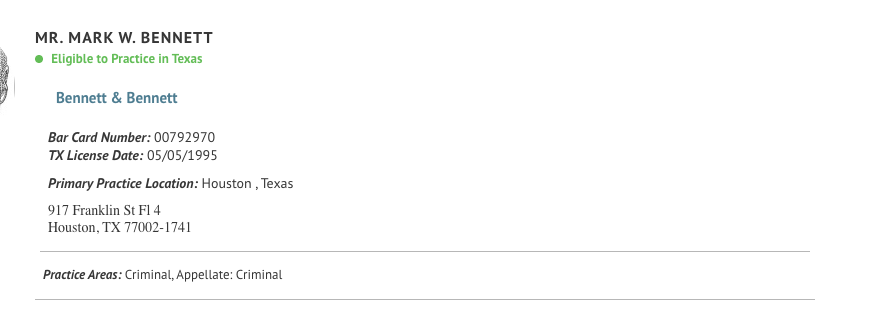
Two things to notice. First, the bar number itself. Texas bar numbers are all eight digits, with leading zeros for older lawyers. A bar number starting with “24” was issued after about 2003, when the State Bar changed its numbering convention. Lower leading digits mean a longer career.
Second, the disciplinary-history line. A public reprimand, a suspension, or a probated suspension shows here. Most lawyers have nothing on this line, and that is normal. If something is there, read it.
Step 2: Look up the cases
Take the bar number to search.txcourts.gov. This is the unified case-management system for every Texas appellate court. The interface is dated, but the data is comprehensive and refreshed nightly.
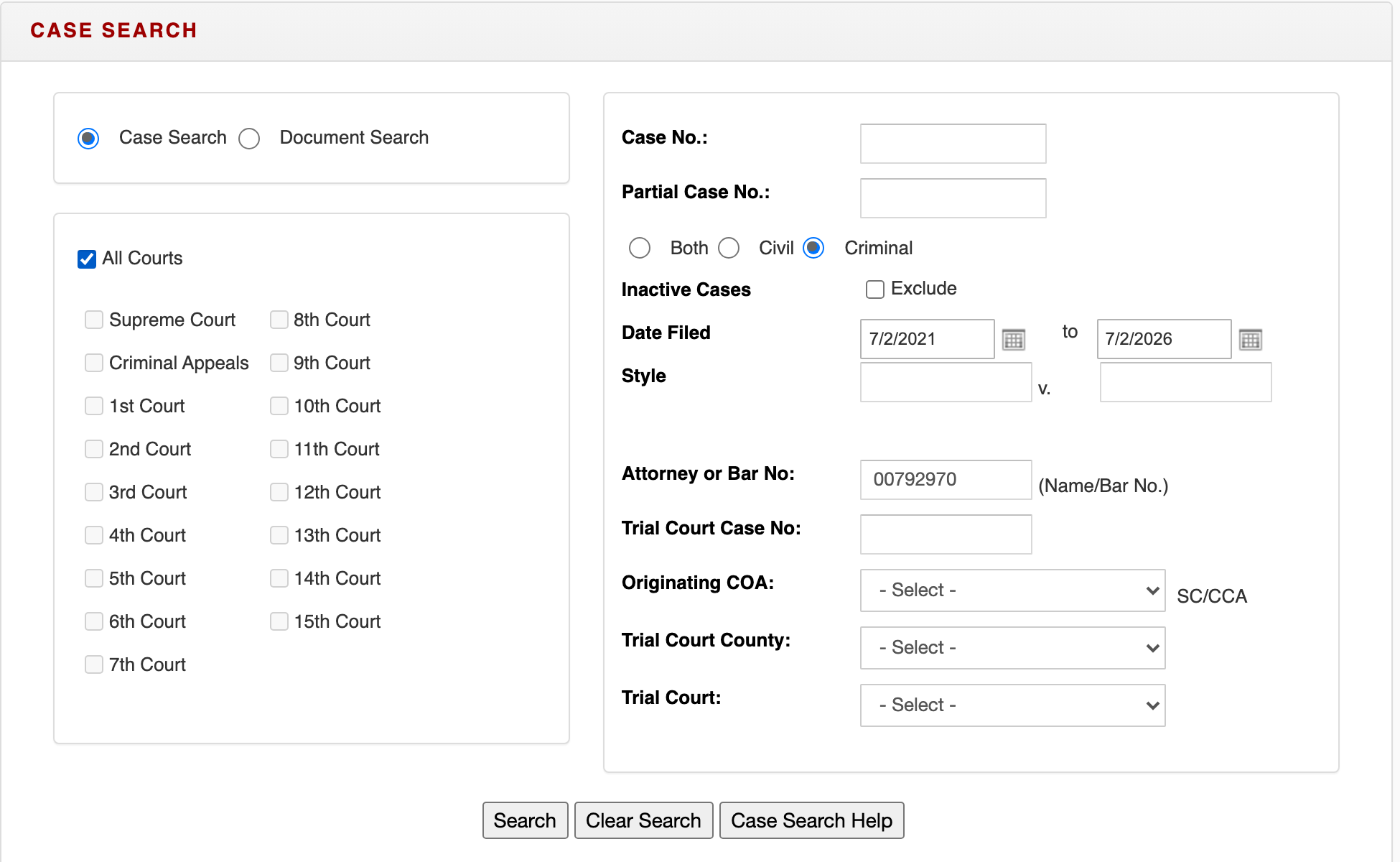
In the search form:
- Leave “Search by Case” selected.
- Enter the bar number in the Attorney or Bar No field.
- Select Criminal as the case type, unless you also want to see the lawyer’s civil-appellate work.
- Set Date Filed to the last five years. Older than that is history; the question you are answering is what the lawyer is doing now.
- Leave All Courts checked, so you see every Court of Appeals plus the Court of Criminal Appeals.
- Click Search.
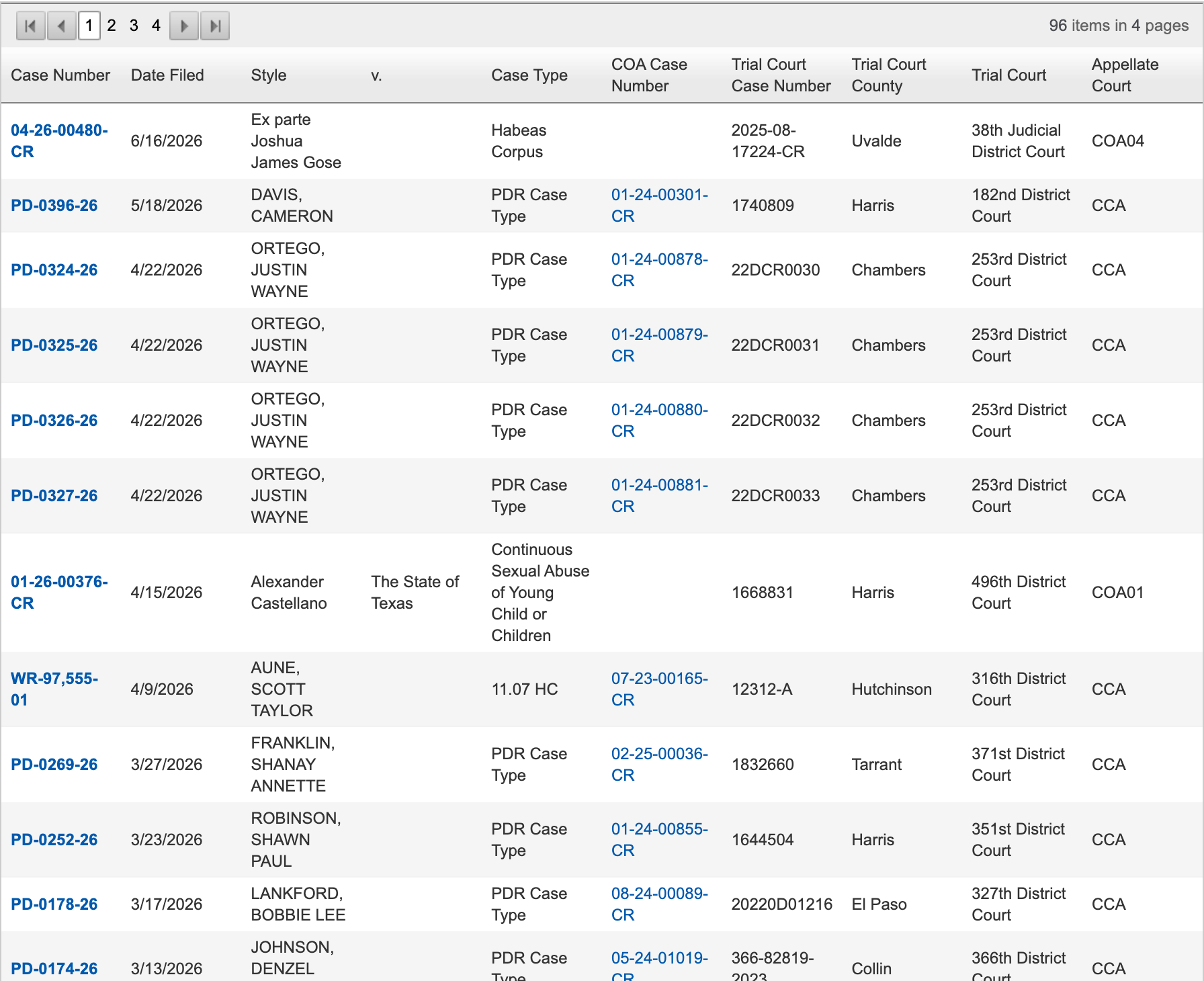
The results come back as a table: case number, date filed, party name, case type, originating court, and so on, with 25 cases per page. The pager at the bottom-right tells you the total.
Step 3: Read the case-number prefixes
Every case number on the results page tells you what kind of work the lawyer was doing. There are three categories that matter for a criminal-appellate practice:
- NN-YY-NNNNNN-CR (for example,
14-25-00138-CR): a direct appeal of a conviction, in one of the fourteen Courts of Appeals. The first two digits are the court (1st through 14th). This is the core of an appellate practice. - PD-NNNN-YY (for example,
PD-0692-25): a Petition for Discretionary Review filed in the Court of Criminal Appeals. The CCA hears about three to five percent of all PDRs. Filing one is a normal part of appellate work; getting one granted is a meaningful accomplishment. Winning one is a huge victory. - WR-NN,NNN-NN (for example,
WR-96,658-01): an article 11.07 post-conviction application for writ of habeas corpus, the channel for relief from a final felony conviction. These are filed in the trial court but assigned a CCA docket number.
You will also see -CV case numbers (civil), and possibly AP- (direct appeal of a death sentence). For a criminal-appellate lawyer evaluation, count the first three and the last.
What good looks like
One more thing before you count: appeals are an uphill battle at the best of times. Most appeals end in affirmance. The Court of Criminal Appeals agrees to hear three to five petitions out of a hundred, and it denies the vast majority of habeas applications. Read any lawyer’s numbers, ours included, against those odds.
A working criminal-appellate practice over a five-year window shows:
- Volume. A lawyer holding themselves out as an appellate specialist should have dozens to hundreds of criminal cases in the last five years. Briefing a single appeal may take weeks. Three appeals in five years is a general practice that handles the occasional appeal.
- Mix. Direct appeals, PDRs, and 11.07 writs should all appear. Each one is a different skill. A lawyer who only files direct appeals and never a PDR is leaving issues on the table. A lawyer who only files 11.07 writs is doing post-conviction collateral attack, which is related but different work.
- Recency. The newest case should be within the last few months. The oldest should be within the date window you set. A lawyer whose newest case is from 2018 has stopped doing appellate work, regardless of what the website still says.
- Some wins. Open three or four random cases by clicking the case number. Each case page shows an “Events” section with terminal dispositions. For appeals, look for
Opinion issuedwith dispositionAFFIRMED,REVERSED, orDISMISSED. For PDRs, look forPDR DISPwithGrantedorRefused. For 11.07 writs, look forOPINION ISSDorACTION TAKENwithHC Relief grantedor some form of denial.
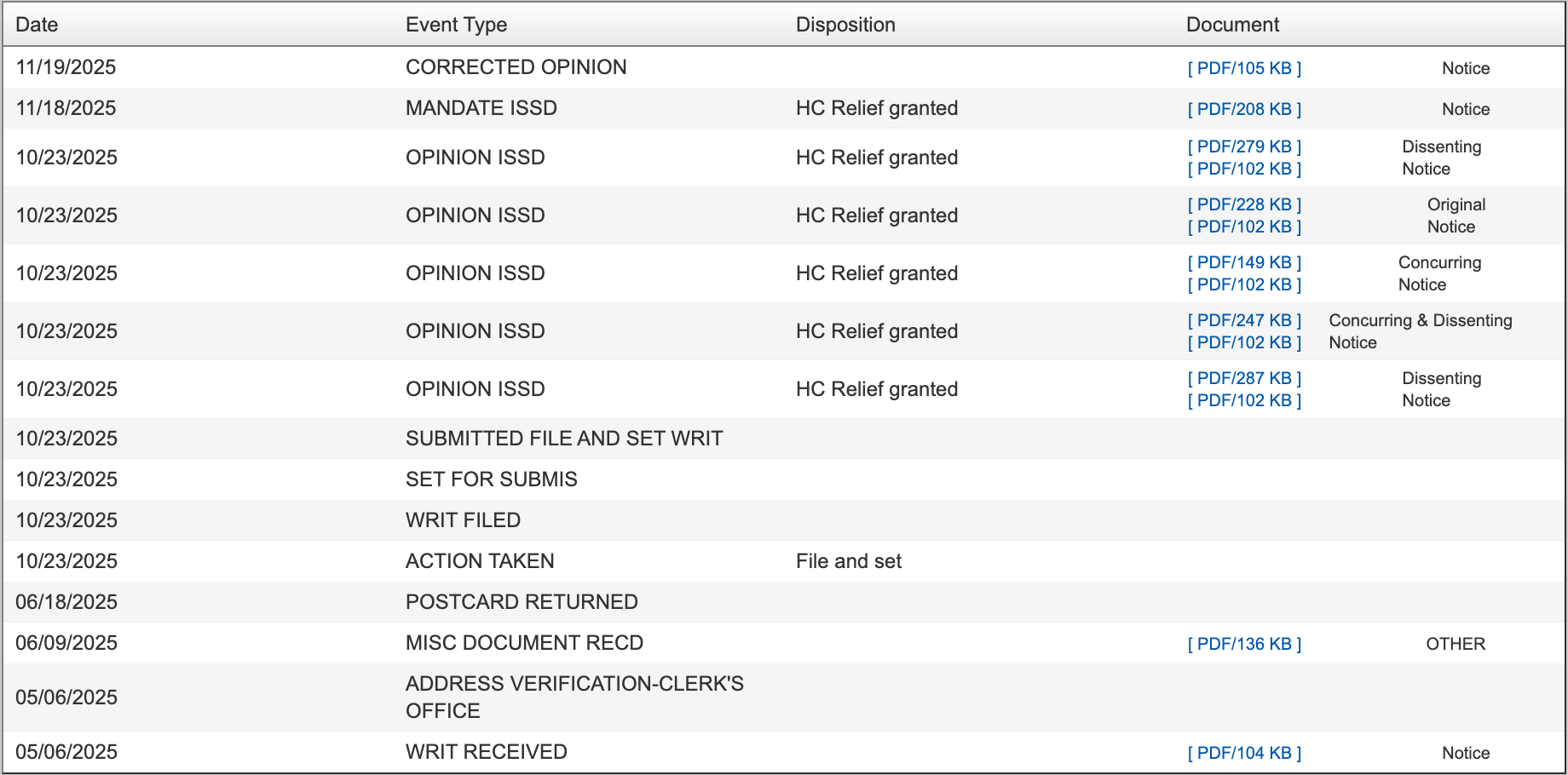
Against those base rates, a lawyer with a few grants on PDRs or writs is doing something right. A lawyer with none, over a hundred filings, is doing volume without selection.
Red flags
The case-search data exposes a few patterns that prospective clients usually cannot see from the marketing.
- Zero criminal cases in the last five years. We have run this exercise on lawyers whose websites prominently advertise criminal-appellate services. Some of them have not filed anything in a Texas appellate court since 2010 or earlier. They are not actively practicing in this area, whatever the website says.
- Only direct appeals, no PDRs. A lawyer who handles direct appeals but never files a PDR is sending clients home after the intermediate-court loss with the words there’s nothing else to do. That is sometimes true, and often not. The PDR is the next step.
- Most appeals dismissed. A high count of
DISMISSEDentries on direct appeals usually means the lawyer is taking appeals where there is nothing to appeal, accepting the engagement fee, and then withdrawing the appeal once the record arrives and there are no issues. Those are appeals that should not have been filed, or issues the lawyer should have found. - Volume without recency. A lawyer whose case list shows 300 cases but the newest is two years old has wound down the practice. The number means nothing for your case.
- “Nationwide appellate firms” headquartered out of state. Several firms run heavy paid placement on Texas appellate queries from offices in Florida, California, or other states. Their websites list “Texas appeals” as a practice area, sometimes with a Houston or Dallas suite address that is a virtual office. Run the bar-number check: the lawyers named on those sites are usually licensed only in their home state, with no Texas bar number to look up.
- Bios that lead with the trial side of the practice. A defense lawyer’s website that opens with former federal prosecutor or over 30 years of trial experience and then mentions appeals as a secondary practice area is telling you what the lawyer actually does. The case-search numbers usually confirm it.
- Free consultations for serious appellate matters. At a first consultation, free or paid, no lawyer has read your record, the briefs, or the opinion under review. The consultation can cover process, timelines, and fees. An opinion about your issues or your chances at that stage would be a guess: we read the record once we are fully hired, and we hold our opinions about issues and outcomes until we have read it. Firms that lead with a free-consultation pitch on criminal appeals are selling intake, and a lawyer who offers a merits opinion in a free phone call is guessing out loud.
Three things this exercise cannot tell you
The data covers volume and outcomes. Three things it leaves out:
First, case selection matters. A lawyer who takes every appeal that walks in the door will have a worse reversal rate than a lawyer who only takes appeals with real issues. A lawyer who refuses to file weak PDRs will have a higher grant rate than a lawyer who files every losing case. The numbers reward selectivity. Before being hired, a lawyer usually cannot know whether your record holds a viable issue; the record comes later. What a lawyer can tell you up front is when the answer is already knowable: you waived appeal in your plea papers, or the deadline has passed. You want the lawyer who says so before taking your money.
Second, a “no” from a careful lawyer doesn’t mean a “yes” elsewhere is correct. A lawyer who can’t say no to fees can’t say no to weak cases. If a careful lawyer tells you your case has no viable issue and the next lawyer tells you it does, that is information about the next lawyer, not about your case. It also explains where the dismissed appeals come from — lawyers who say yes to everything file appeals that have nothing in them, and those appeals end up in the dismissed pile we just told you to look for.
Third, the brief is what wins. An appellate court reverses because the brief identifies a legal error, frames it persuasively, and supports it with authority. The case list shows the outcome. It does not show the writing. Ask for sample briefs. A lawyer who writes their own briefs will share recent work without hesitation.
How we look on this exercise
Bar number 00792970, Mark W. Bennett. Search.txcourts.gov, last five years, Criminal, All Courts: 96 cases. In the courts of appeals, 31 (direct appeals, pretrial habeas appeals, and mandamus). In the Court of Criminal Appeals, 59 PDR dockets and six writ dockets. The Court of Criminal Appeals granted review in 22 of those PDR dockets. Eight were petitions we wrote. In the rest, the grant came before we did: State’s petitions we were defending against, and granted petitions—three of them handwritten by the clients themselves—where we volunteered to brief and argue the merits. Habeas relief granted: one in this window. The window undercounts; writ dockets carry their filing dates, and our grants reach back a decade: 10 clients in all, Kerry Max Cook among them, one of them hidden by expunction. Newest case: filed in August 2026. Board Certified in both Criminal Law and Criminal Appellate Law by the Texas Board of Legal Specialization. Both certifications.
Do the same exercise for everyone else you are considering. Then make your decision.
Ready to hire us
Call 713-224-1747, or use the contact form. We will run the bar-number lookup with you on the phone if that helps.